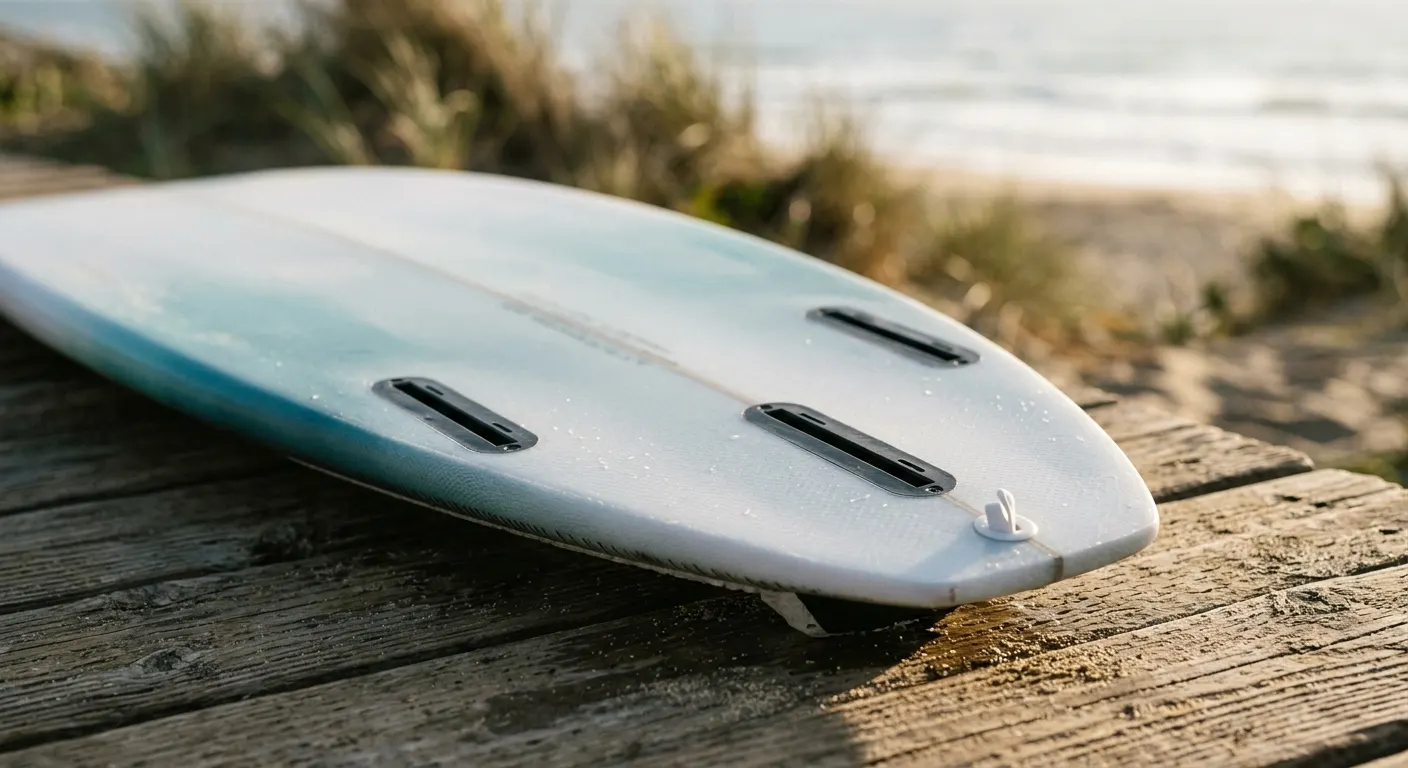
Thruster, Quad, or Twin: Which Fin Setup Suits Your Board and Your Waves
By Swellkin . 8 min read . Updated September 2026
Fin count and layout change how a board turns, drives, and releases more than almost any other choice you make after buying the board itself. Thruster, quad, and twin are the three main setups, and each rewards a different kind of wave and riding style. Every fin set Swellkin currently carries, including the FCS II Performer PC Tri Fin Set , is built as a three-fin thruster set, so this guide walks through what each layout actually does before pointing you to the thruster options that match your board and the waves you surf.
Quick answer
A thruster (three fins) is the most versatile setup and fits the vast majority of shortboards; a quad (four fins, no centre) adds speed and drive in small-to-medium surf; a twin (two fins) feels loose and playful in weak waves. Swellkin's current fin lineup, led by the FCS II Performer PC Tri Set, is built for thruster setups.
This guide contains affiliate links. Swellkin may earn a commission at no cost to you.
What does a thruster setup do for your surfing?
The FCS II Performer PC Tri Fin Set is the clearest example of thruster design: three similarly sized fins that split hold, drive, and release evenly, which is why most shortboards ship with a thruster setup as the factory default.
A centre fin resists side-slip and adds hold, while the two side fins generate most of the turning drive. That balance is why the thruster remains the standard recommendation for surfers moving up from a soft-top beginner board to a proper shortboard, and why shapers keep designing around it decades after its introduction. Within Swellkin's lineup, every current fin set other than the FCS II Power Glass Longboard Fin (8 inch) is built as a thruster tri set, which reflects how common the layout is across everyday shortboards.

FCS II Performer PC Tri Fin Set
The FCS II all-conditions benchmark: AirCore construction with Inside Foil Technology that reduces drag and keeps this set feeling lively in varied surf.

FCS II Power Glass Longboard Fin (8 inch)
A power glass single fin for FCS II longboard centre boxes, offering a traditional flex pattern with modern construction for nose-riding and cross-stepping.
What does a quad setup change on a board built for one?
A true quad setup swaps the centre fin for a second pair of side fins, and while Swellkin's catalog does not currently stock quad-specific templates, riders drawn to that looser, faster feel often like the playful flex of the Endorfins KS1 Fin Set (FCS II or Futures) within a thruster configuration instead.
Removing the centre fin reduces drag and lets the tail release more freely, which is why quads are popular in fast, hollow, down-the-line surf and on fish-shaped boards that already carry speed. The tradeoff is less hold through long, drawn-out turns, since no centre fin resists side-slip. If your board has genuine quad boxes, two pairs and no centre box, buy a template built for that layout rather than adapting a thruster set, since the size relationship between the front and rear fins in a quad is different from a tri set.

Endorfins KS1 Fin Set (FCS II or Futures)
Kelly Slater's signature fins made from recycled materials, with a hollow construction that literally floats and a playful, responsive feel designed for active, creative surfing.
What does a twin setup feel like, and who is it for?
A twin setup uses two side fins with no centre fin at all, and the FCS II longboard single fin sits at the opposite end of that spectrum: one fin built for glide and cross-stepping, not the loose, drifty turns a twin delivers in small surf.
Twins are most associated with retro fish shapes and softer, weaker days, when a thruster's extra hold is not needed and the free, skatey release of a two-fin layout is more fun than fast. Genuine quad and twin templates are worth exploring directly from FCS or Futures once you know your board's exact box layout. Swellkin's current lineup is built around thruster performance and the noseriding-focused single fin covered above.
FCS II Power Glass Longboard Fin (8 inch)
A power glass single fin for FCS II longboard centre boxes, offering a traditional flex pattern with modern construction for nose-riding and cross-stepping.
Does your fin box system decide the setup for you?
The Futures Fins John John Florence Alpha Tri Set only fits Futures single fin boxes, according to the product listing, while the FCS II Performer PC Tri Fin Set clicks into FCS II's two-tab boxes, so your board's boxes narrow the field before wave size or setup type even enters the decision.
Box system and setup type are independent variables: a board can carry FCS II boxes and still be built for a thruster, a quad, or a twin layout, and the same is true for Futures boxes. The Endorfins KS1 Fin Set (FCS II or Futures) is the one set in Swellkin's lineup sold in either FCS II or Futures fitting, which helps if you are unsure which system your board uses or you own boards on both systems and want one fin philosophy across the quiver. The FCS II Power Glass Longboard Fin (8 inch) is built specifically for FCS II centre boxes on longboards and will not fit a Futures-boxed board.
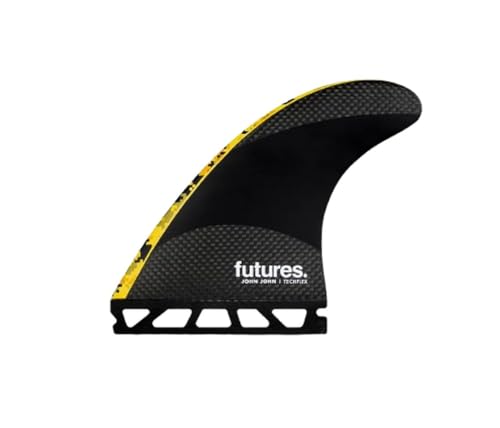
Futures Fins John John Florence Alpha Tri Set
The entry point for real performance in the Futures system: C6 air-infused carbon construction for a lively flex pattern at an accessible price.
FCS II Performer PC Tri Fin Set
The FCS II all-conditions benchmark: AirCore construction with Inside Foil Technology that reduces drag and keeps this set feeling lively in varied surf.
Endorfins KS1 Fin Set (FCS II or Futures)
Kelly Slater's signature fins made from recycled materials, with a hollow construction that literally floats and a playful, responsive feel designed for active, creative surfing.
FCS II Power Glass Longboard Fin (8 inch)
A power glass single fin for FCS II longboard centre boxes, offering a traditional flex pattern with modern construction for nose-riding and cross-stepping.
Which thruster fin set fits your board and wave conditions?
The FCS II Performer PC Tri Fin Set is the best all-around thruster pick for intermediate to advanced surfers who want one set that holds up from knee-high to head-high surf without swapping fins for every session.
For a lower-priced entry into real performance on a Futures-boxed board, the Futures Fins John John Florence Alpha Tri Set uses C6 air-infused carbon construction, according to the product listing, at a meaningfully lower price than the flagship carbon sets. Surfers who prioritize speed and down-the-line drive over a loose, skatey feel should look at the Futures AM2 Honeycomb Tri Fin Set , whose honeycomb construction gives a high stiffness-to-weight ratio built for fast, direct surfing in decent-sized waves. If sustainability matters as much as performance, the FCS II Performer Neo Glass Eco Tri Fin Set uses 50 percent recycled glass fiber and bio-resin, per the manufacturer, and performs comparably to standard glass construction at the intermediate level. Longboarders should skip all of the above and go straight to the FCS II Power Glass Longboard Fin (8 inch) for noseriding and cross-stepping on an FCS II centre box.
The short version: match your board's fin boxes first, pick a thruster set for everyday versatility, and only look outside Swellkin's current fin lineup if your board is built specifically for a quad or twin layout.
FCS II Performer PC Tri Fin Set
The FCS II all-conditions benchmark: AirCore construction with Inside Foil Technology that reduces drag and keeps this set feeling lively in varied surf.
Futures Fins John John Florence Alpha Tri Set
The entry point for real performance in the Futures system: C6 air-infused carbon construction for a lively flex pattern at an accessible price.

Futures AM2 Honeycomb Tri Fin Set
Al Merrick signature Futures fins with honeycomb construction for exceptional speed and drive, designed for surfers who want to generate and maintain speed.

FCS II Performer Neo Glass Eco Tri Fin Set
Sustainably produced from 50 percent recycled glass fiber and bio-resin, these fins deliver all-around performance at a price that suits intermediate surfers moving beyond stock fins.
FCS II Power Glass Longboard Fin (8 inch)
A power glass single fin for FCS II longboard centre boxes, offering a traditional flex pattern with modern construction for nose-riding and cross-stepping.
Featured in this guide
FCS II Performer PC Tri Fin Set
The FCS II all-conditions benchmark: AirCore construction with Inside Foil Technology that reduces drag and keeps this set feeling lively in varied surf.
Futures Fins John John Florence Alpha Tri Set
The entry point for real performance in the Futures system: C6 air-infused carbon construction for a lively flex pattern at an accessible price.
Futures AM2 Honeycomb Tri Fin Set
Al Merrick signature Futures fins with honeycomb construction for exceptional speed and drive, designed for surfers who want to generate and maintain speed.
FCS II Performer Neo Glass Eco Tri Fin Set
Sustainably produced from 50 percent recycled glass fiber and bio-resin, these fins deliver all-around performance at a price that suits intermediate surfers moving beyond stock fins.
Endorfins KS1 Fin Set (FCS II or Futures)
Kelly Slater's signature fins made from recycled materials, with a hollow construction that literally floats and a playful, responsive feel designed for active, creative surfing.
FCS II Power Glass Longboard Fin (8 inch)
A power glass single fin for FCS II longboard centre boxes, offering a traditional flex pattern with modern construction for nose-riding and cross-stepping.
Keep reading
Related roundups
FAQ
Frequently asked questions
Can I put a thruster fin set in a quad-boxed board?+
No. A quad-boxed board has two pairs of fin boxes and no centre box, while a thruster set is designed for two side boxes plus one centre box. The two layouts are not interchangeable: a thruster set left with an empty pair of quad boxes will not perform as designed, and a quad-specific template will not fit a thruster board's centre box. Match the fin set to the box layout your board actually has, not the setup you want to try.
Are FCS II and Futures fins interchangeable?+
No. FCS II uses two small tab boxes per fin that click in tool-free, while Futures uses one long single box that requires a key. The fin bases are shaped differently for each system and will not fit the other box type. Check your board's tail before buying any fin set; the Endorfins KS1 is one of the few sets sold in both fittings, but it still ships as one or the other, not a universal fin.
Is a quad faster than a thruster?+
Generally yes, in the right conditions. Removing the centre fin in a quad reduces drag and lets a board release more freely off the tail, which shows up as extra speed down the line in fast, hollow waves. A thruster trades some of that raw speed for more hold and control through long, drawn-out turns, which is why it remains the default setup for most everyday surfing.
What fin setup should a beginner use?+
A thruster. It is the setup most boards, instructors, and shapers are built around, and it gives a predictable mix of hold, drive, and release that makes it easier to learn proper technique. The FCS II Performer PC Tri Fin Set or the Futures JJF Alpha Tri Set are reasonable starting points once you are ready to move beyond a board's stock fins.
Does fin size matter more than fin count?+
Both matter, but count and layout decide the basic character of the ride, while size fine-tunes it within that layout. Larger fins add hold and drive in any setup; smaller fins add looseness and release. Once you have settled on thruster, quad, or twin, sizing up or down within that layout is the next lever to adjust for wave size and your weight.